The medieval beginnings of Băișoara settlement are lost in ancient times, its first documentary attestation being late, only in 1426 when Ladislau, the son of Peter, wishing to enter into the control of his estates in Iara (Jara), Iara de Sus (Fel Jara), Băioara (Banya), Ocolișel (Kys Aklos), Great Ocolișul (Nagy Aklos), Cacova Ierii (Ivanfalva), Surduc (Szurduk), Remetea (Remete), Berchieș (Berk..enes), Sind (Szind), Cean (Csăn) , Boldocz settlement near Viișoara and Szent Ivan strikes against the opposition raised by the members of the Szarkadi (Szarkad) and Franczias family who ruled in the first half of the 15th century, as vase nobles, trustworthy, cited as witnesses i of the Transylvanian voivodeship or deputy. Obviously, we cannot get over the question of the meaning of the name of Bánya, that is, mine or bath, which has the settlement from the first documentary mention as well as in correlation with others that have succeeded.
We believe that the beginnings of the settlement of a medieval community can be linked to the mining of the place. According to some older opinions, the evolution of the settlement would have been in correlation with that of the Yesterday, a point of view that we consider realistic and acceptable, allowing us to support the following evolution. Due to the resources of the basement, in the „upper” boundary of the Iara settlement (Felső Jara), a gold mining operation has developed over time. In fact, we believe that this part was called in 1449 „the mine of Iara with those related to it”.
In addition to the mine or the gold mines another settlement gradually developed called Olah Banya (Romanian Bath) or later Băișoara (Kis Banya), a time component of the domain of Iara fortress, and later came into the possession of more noble families such as Jarai, Zichy, Csan, Lupsai, Zarkadi, Kende etc. In fact the documents kept for the period 1450-1540 prove the said. Thus, for example, members of the Zarkadi family gradually lose some of the wealth they obtained in Băișoara by beating them in exchange for sums of money taken as a loan in different situations in favor of members of the Lupșa family. Also on the way of unsecured loans to the Csan family loses some of the possessions here in favor of the salt committees in Turda.
Interesting is the situation from October 1482, when another member of the same family borrows a sum of money and draws up his will, regulating a possible succession in case he dies. All the measures are taken by the one concerned because it was a great plague (pestilentia) and many of them died and then he was due to go to the high army against the Turks who were too courteous and enemies of Christianity. Obviously he was not the only one from Băișoara who rose against the Turks. Unfortunately the sources are silent and the acts of bravery or difficult to restore the life of the ordinary man, of the ordinary peasant, which the acts most often do not mention. From a document from 1532 we find that on the water of Ieri there was a mill with two wheels, that between Băișoara and the water of Iara, on the place called „Valea lui Damos” (Damos welgye) there were Jacobin sessions with the plowing land.
Other similar sessions, but also with hay, are mentioned elsewhere. As for those who worked these sessions, the documents speak only of the „session” of Brinde, Simion, Lupp Mihail or Bancsul Romanul. Along with these were, of course, many who cared about the cultivation of the land, mowing hay, raising animals, part with mining but also with the handling of weapons as needed. The specialized literature does not mention the existence of any medieval fortress built in Săcel-Băișoara. However, since the end of the 19th century, the geographical descriptions of the time record such a fortress, compared to that of Cacova Ierii. Its ruins are kept until today in the border of Săcelului and can be seen in the place called „Cetate”, being attributed by the locals to the voivode Gelu.
Of course, we cannot ignore this reality which confirms that in the village of Săcel, Băișoara commune, there was in the past a fortress with obvious defensive features, probably raised by the care of an older nobleman. However, we believe that an acceptable limit for its dating can be the second half of the fifteenth century, the beginnings being in a larger context in which many other cities were raised to ensure defense against possible hordes. by the Turks and Tatars set off after their prey and escaped by robbery raids. Moreover, the locals perpetuate the tradition of belonging to the fortress of a „grof” who would have closed his own daughter here.
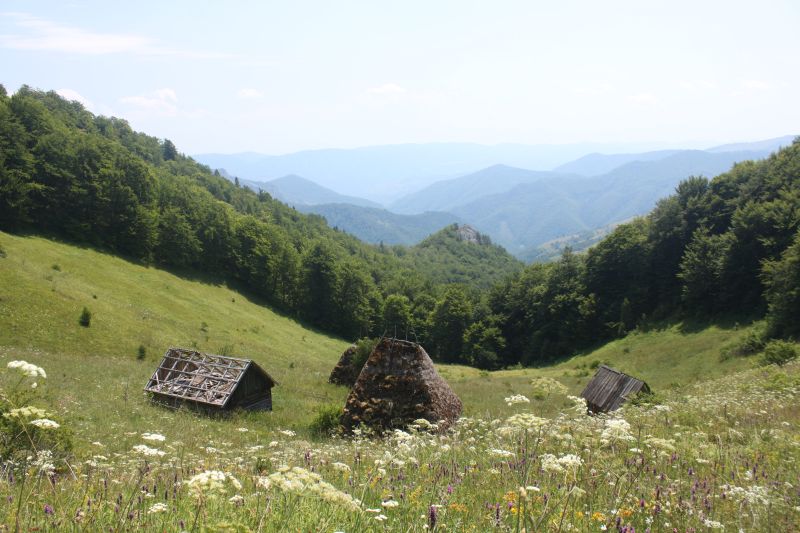
 Băișoara - a beautiful place to visit and relax